



Zapraszamy na wernisaż międzynarodowej wystawy fotografii „Granice widzenia / Limits of Seeing", organizowanej przez Łódzkie Towarzystwo Fotograficzne.
Otwarcie wystawy odbędzie się 23 czerwca 2026 r. o godz. 18.30 w Galeria Fotografii im. Eugeniusza Hanemana, podczas trwania Fotofestiwal.
Wystawa czynna będzie od 23 do 29 czerwca 2026 r., w tym również w sobotę 27 czerwca i niedzielę 28 czerwca.
We cordially invite you to the opening of the international photography exhibition Limits of Seeing, organized by The Photographic Society of Łódź
The exhibition will open on 23 June 2026 at 6:30 p.m. at the Eugeniusz Haneman Photography Gallery in Łódź, during the Fotofestiwal – International Festival of Photography in Łódź.
The exhibition will be open to visitors from 23 to 29 June 2026, including Saturday, 27 June and Sunday, 28 June.
Autorzy:
Katarzyna Berent, Jacek Boczar, Barnaba Bonati, Paweł Buczek, Piotr Chabior, Dominika Cybuch, Barbara Czernilewska, Zbigniew Głuszczak, Sławomir Grzanek, Barbara Harsch, Witold Jankowski, Zbigniew Januszek, Artur Jastrzębski, Dariusz Kanak, Tymoteusz Lekler, Marta Lityńska, Monika Malicka, Yunagi Miki, Mariusz Nowicki, Tadeusz Papis, Françoise Remy, Wioletta Rzepa, Agnieszka Sawicka, Mariola Siwińska, Joanna Słowikowska, Urszula Sobieszek, Maciej Split, Piotr Statkiewicz, Piotr Szczegłów, Agnieszka Tobiasz, Dominika Wenz, Krzysztof Ziętkowski.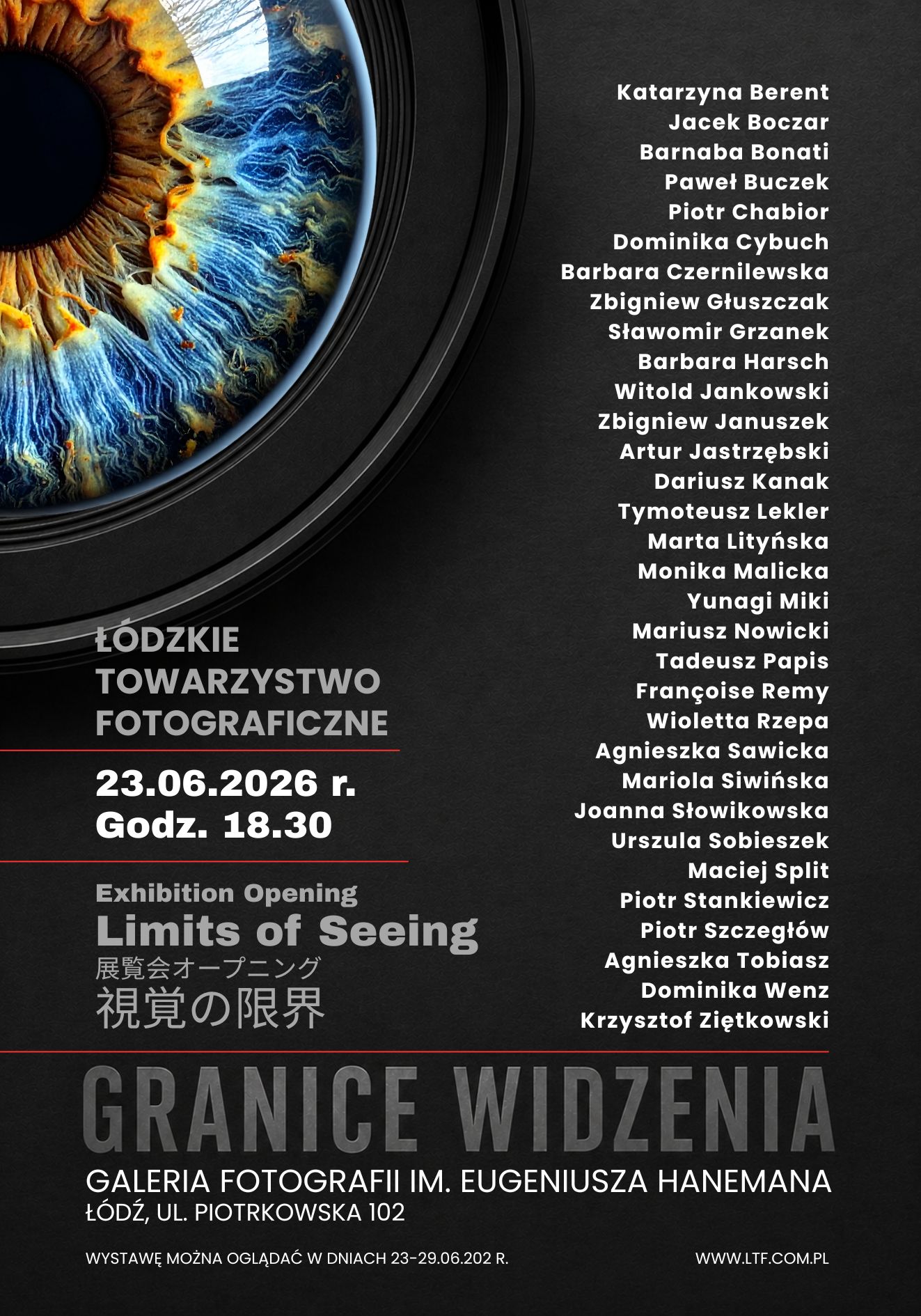
„Granice widzenia / Limits of Seeing" to wielowątkowa opowieść o sposobach postrzegania świata i o tym, jak fotografia pozwala przekraczać granice codziennego doświadczenia. Tematem wystawy jest to, co dostrzegalne i ukryte, oczywiste i niejednoznaczne, obecne w kadrze oraz pozostające poza nim. Autorzy podejmują refleksję nad samym aktem widzenia, pokazując, że każdy obraz jest nie tylko zapisem rzeczywistości, lecz także interpretacją, emocją i osobistym doświadczeniem.
Prezentowane fotografie prowadzą widza przez różnorodne przestrzenie – od dokumentu i reportażu, przez portret, fotografię uliczną i krajobrazową, aż po eksperyment, kreację i poszukiwania konceptualne. W wielu pracach granice widzenia stają się metaforą ograniczeń ludzkiej percepcji, pamięci i wyobraźni. Inne zwracają uwagę na zjawiska, osoby i miejsca, które na co dzień pozostają niezauważone, ukryte w cieniu pośpiechu, rutyny lub społecznych schematów.
Wystawa skłania do zadawania pytań: gdzie kończy się obserwacja, a zaczyna interpretacja? Jak wiele mówi nam obraz, a jak wiele pozostawia w sferze domysłów? Czy fotografia odsłania prawdę o świecie, czy raczej tworzy jej własną, subiektywną wersję? Odpowiedzi na te pytania nie są jednoznaczne – i właśnie w tej niejednoznaczności tkwi siła prezentowanych prac.
„Granice widzenia / Limits of Seeing" gromadzą twórców reprezentujących różne środowiska, doświadczenia i wrażliwości artystyczne. Obok autorów związanych z organizacjami fotograficznymi swoje prace prezentują także fotografowie niezależni, dla których fotografia jest przestrzenią osobistej wypowiedzi i twórczego dialogu ze światem. Dzięki tej różnorodności wystawa staje się miejscem spotkania wielu perspektyw, kultur i sposobów rozumienia obrazu.
To nie tylko prezentacja fotografii, ale również zaproszenie do uważnego patrzenia, odkrywania znaczeń ukrytych pod powierzchnią obrazu oraz poszukiwania własnych odpowiedzi na pytanie o granice ludzkiego widzenia – zarówno w sensie dosłownym, jak i symbolicznym. W czasach przesytu obrazów wystawa przypomina, że prawdziwe widzenie wymaga zatrzymania, refleksji i otwartości na to, co nie zawsze jest widoczne od pierwszego spojrzenia.
Limits of Seeing is a multifaceted exploration of the ways we perceive the world and of how photography enables us to transcend the boundaries of everyday experience. The exhibition focuses on what is visible and hidden, obvious and ambiguous, present within the frame and existing beyond it. Through their works, the participating artists reflect on the very act of seeing, demonstrating that every image is not only a record of reality but also an interpretation, an emotion, and a personal experience.
The photographs on display guide viewers through a wide range of visual territories—from documentary and reportage photography, through portraiture, street and landscape photography, to experimentation, artistic creation, and conceptual inquiry. In many of the works, the limits of seeing become a metaphor for the boundaries of human perception, memory, and imagination. Others draw attention to phenomena, individuals, and places that often go unnoticed, concealed by the pace of everyday life, routine, or social conventions.
The exhibition encourages viewers to ask fundamental questions: Where does observation end and interpretation begin? How much does an image reveal, and how much does it leave to speculation? Does photography uncover truths about the world, or does it create its own subjective version of reality? The answers are far from straightforward—and it is precisely this ambiguity that gives the exhibited works their power and resonance.
Limits of Seeing brings together photographers representing diverse backgrounds, experiences, and artistic sensibilities. Alongside artists affiliated with photographic organizations, the exhibition features independent photographers for whom photography serves as a medium of personal expression and creative dialogue with the world. Through this diversity, the exhibition becomes a meeting place for multiple perspectives, cultures, and ways of understanding the photographic image.
More than a presentation of photographs, the exhibition is an invitation to look attentively, to discover meanings hidden beneath the surface of images, and to seek one's own answers to questions about the limits of human vision—both in its literal and metaphorical sense. In an age saturated with images, Limits of Seeing reminds us that genuine seeing requires pause, reflection, and openness to what may not be apparent at first glance.